Search This Blog

Monday, December 17, 2018

Dapsone, wonder drug? Not just about killing germs


People have been excited about trying Dapsone for PTLDS.  Horowitz has had good clinical results. Then Zhang did the test tube trials and it was a bust. It’s a sulfa drug and I have not been impressed using sulfa drugs treating Lyme.  Dapsone is used for leprosy, skin conditions including acne and dermatitis herpetiformis – the skin condition associated with celiac disease. With this portfolio I wouldn't have thought Lyme.  Dapsone may be a true wonder drug, one off the radar since it has been around forever (since 1937, predating penicillin, first synthetized in 1908) and there is no money in it for pharmaceutical companies. But what a drug! 

There are many ways the drugs may be repurposed and it is not just about killing germs, at least not directly.
Dapsone has tremendous anti-inflammatory properties with widespread effects on immune function. It positively impacts:  effector cells, cytokines, adhesion molecules, prostaglandins, leukotrienes, interleukins, tumor necrosis factor, leukocyte activation, ROS (reactive oxygen species), folate antagonist (this I knew) and a lot more. 
It is active against bacteria and protozoa, including malaria (Babesia?). 
It is bacteriostatic, not bactericidal and suppresses: strep, staph, pneumococcus, mycobacteria and more. 

I has been successfully used in rheumatoid arthritis with efficacy comparable to more toxic drugs.
It has steroid sparing effects which may make it useful in a wide variety of inflammatory and autoimmune disorders
It prevents UV associated photosensitivity (think doxy during the summer). 
It is well adsorbed into all tissues, including the brain. It may have neuroprotective effects (human stroke study). ?Brain fog in Lyme patients. 
It may have anti-cancer effects, even against brain tumors. 
It might be effective for life extension (works in a worm).  We are not worms.  
It may help kill Lyme through non-antibiotic effects. For example, it improves immune function and generates ROS which have natural antibiotic properties. 
There is much more.
It has potential toxicity and side effects which must be monitored.  

It sounds too good to be true, so I include the reference.

Archives of Dermatology (2014) 306:103-124, Wozel, Blasum (University of Dresden, Germany)
Open access with extensive references.

Saturday, December 15, 2018

Biofilm induced inflammation in mouse model and rapid relapsers


Thank you, Dr. Zhang, for your dedication and hard work.  The latest paper published October 11, 2018 is groundbreaking. 
The latest research has moved from the test tube to the mouse model.  Test tube research cannot be applied directly to human medical care and neither animal model research, but it moves the ball closer to the goal.
Doctor Zhang has both an MD and a PhD. He is highly skilled researcher but also has the bona fides to discus clinical, human disease with credibility. 
He speaks of PTLDS, using the term frequently with words carefully chosen. He states the cause of PTLDS is unknown.  But the hypothesis that persistent infection plays a large role is written between the lines. 
I must thank him first for describing 2 types of PTLDS.  This is something I have long railed about.  In the first type(type 1 PTLDS) a patient receives early treatment and experiences clinical failure. In the second (type 2 PTLDS), the diagnosis is delayed and therefore early treatment is never provided. 
 The 4 NIH sponsored clinical trials examined only type 1 PTLDS.  The most recent trial was performed more than 12 years ago. The trials were limited with small patient numbers and have been controversial since day one.  The meaning and interpretation of the study results has been hotly contested.  Dr. Fallon’s expressed beliefs which contradict those of the IDSA were recently described on these pages. 
The IDSA has recently stated that more funding for Lyme research is unnecessary since all is already known. This is frightening. When is more data, evidence, information and science a bad thing?  I thought suppression of scientific inquiry is something left behind with the middle ages. 
For me one of the clinical mysteries has been the rapidity with which clinical symptoms may relapse when antibiotics are stopped. I think the latest study findings provide clarity here. 
 Lyme bacteria are pleomorphic and exhibit a great degree of phenotypic variability.  In layman’s words “they act like shape shifting aliens” which have widely invaded host bodies. 
The Lyme bacterium is a long, thin, twisted bacteria, a spirochete of the genus Borrelia. There are various species and strains which may cause human disease. 
 Dr. Zhang describes 3-4 variations. The spirochetes may be aggregated in a rapidly growing biomass mathematically referred to as a logarithmic growth phase.  One might think this group with its very high numbers causes the most harm and one would be wrong.  a second group he calls microcolonies (aggregated biofilm like colonies). This is a stationary group showing no active growth.  Individual spirochetes, free swimming are planktonic variants.  In microbiology, planktonic bacteria are distinguished from organisms confined to biofilms.  Most of the planktonic bacteria are round forms. This is not something I have seen described with any other pathogenic bacteria. 
Mice joints are infected (inoculated) with one of the 3 forms.  The biofilm forms caused the greatest joint inflammation in the shortest time.  Planktonic forms came in second place and the least joint inflammation was seen with the large number of actively growing spirochetes.  

The Lyme bacteria which are easily killed do not appear to be the problem. The few do more harm than the many. 
Doctor Zhang suggests that the host may be inoculated with biofilm colonies at the time of the tick bite. I suspect it doesn’t matter that much. There is fluidity.  Round forms and biofilm forms arise quickly irrespective of the inoculum. 
Persister forms express more virulence factors such as decorin binding protein, noted in the paper. 
That brings us back to the question: why do patients relapse quick when antibiotics are withdrawn?

This is what I envision.  The bacteria that cause relapse are dug in and battle hardened and barely kept in check with long term antibiotics. 
Any Star Trek fans? The Starship Enterprise (us) is shooting missiles(antibiotics) at the enemy Klingon ship (Lyme persisters). A force shield is in place and the projectiles can’t penetrate enemy strongholds.   When the Enterprise runs out of ammo the enemy drops it shields and the Klingons open fire. Ouch.

Wednesday, November 14, 2018

PTLDS vs chronic Lyme disease

There has been a lot of buzz about Posttreatment Lyme disease syndrome, PTLDS.

A number of papers over the past couple of years have described the syndrome, working towards a common understanding. Mostly the papers have been written by experts on the "I believe in chronic Lyme disease" side of the divide.

It is a narrowly defined entity. 
PTLDS applies specifically to a group of patients with a history of well characterized acute Lyme disease who were treated according to standard guidelines but despite treatment went on to develop chronic symptoms.  
Not included are:  patients who never had acute Lyme but developed chronic symptoms over time,  patients who in retrospect had acute Lyme, e.g. “summer flu” but diagnosis was delayed for months or years,  patients with a wide array of atypical, mysterious symptoms and syndromes (arguably the largest group), patients suffering with other tickborne coinfections,  patients misdiagnosed because CDC surveillance criteria were inappropriately used for purposes of clinical diagnosis,  patients misdiagnosed with a variety of illnesses ranging from fibromyalgia to MS, and patients infected with novel species of borreliosis and others. 

I have referred to the group as CLD, chronic Lyme disease. 

Nonetheless, the PTLDS name is important because it is now part of the EBM fabric. 

Patients who meet the criteria may escape the labels of psychosomatic disorder, fibromyalgia and CFS. (And, between you and me, once a concept becomes part of the EBM repertoire its definition tends to loosen quite a bit). Don't tell anyone. 

PTLDS opens a door. 
There have been only 4 NIH sponsored studies examining retreatment of Lyme patients. The meaning of the studies has been hotly debated for nearly 2 decades. The most important study is  last, published 10 years ago (Fallon 2008). In the double blinded randomized controlled study of a narrowly defined set of patients the results were positive.  The treatment group had substantial, measurable improvements. The "long-term" active therapy was 10 weeks of IV Rocephin. Cognitive improvements and constitutional improvements were present at 12 weeks. No further treatment was prescribed. At 24 weeks cognitive improvement was lost -- not durable with the 10 week treatment, but constitutional improvements persisted. 

The study conclusions have been misinterpreted and abused by those on the other side. 
Fallon writes in 2012: 
“Each of the U.S. treatment trials on PTLDS have concluded with the recommendation the course of therapy tested in each specific trial was not recommend…”
There is a difference however between whether a trial is effective and whether or not a treatment is recommended.”
“…treatment was shown to be effective.”

To state the obvious:  antibiotics don't make you smarter or fix brain dysfunction.

The studies shows a proof of concept. 
Science provides the cover for biological plausibility:  no effort to eradicate Lyme bacteria in mice, dogs or primates has proved effective. Persistence is demonstrated in test tube studies. Even a human study demonstrated persistence. 

The logic SHOULD be clear.  It is not controversial that people touched by Lyme can be miserable and disabled.  It is not controversial that Lyme bacteria persist. It is not controversial that additional courses of antibiotics have led to clinical improvements in patients -- the best CRTs.

The clinical trials have not helped us find an optimal therapy. But that was not really their purpose. Their purpose was to determine if chronic Lyme is real (not known at the time of the studies) and if patients  improve with additional courses of antibiotics. This was the big question of the day. 

Further research will likely be guided by empiric evidence garnered by practicing physicians. 

The optimal therapy for Lyme is a very complex clinical question and it will take many years or decades for us to get there.

PTLDS patients have a real illness. The patients are suffering with a chronic disabling illness robbing them of any vestige of a quality of life.  Antibiotics have the potential to make their lives better,

PTLDS or chronic Lyme disease?  Not exactly equivalent but heading in that direction. Post Lyme syndrome: RIP.

Any serious discussion about Lyme controversies between the two camps should start here. Chronic Lyme disease --  persistent infection is proved by science.

I will be working on a talk on: How to treat Lyme. I hope some will attend.


Tuesday, November 13, 2018

Medical EMF therapy: Should you use it?


Patients are increasingly using pulsed electromagnetic frequency devices.  They have been doing so for a long time.  The question for me is: what is it all about?


EMF, electromagnetic frequencies are a form of energy which made come from a variety of sources.  It is made up of waves (which are also particles photons-- quantum mechanics – skip this part).
Think of waves on the ocean. If the waves are close together the frequency is higher. When the waves are more spaced out the frequency is lower.  Taller waves have more energy than shorter ones.

EMF is similar.

The waves are usually invisible to our eyes, the exception is light.  Color is determined by frequency of the related EMF wave.
The properties of these waves of energy are amazingly different.  Very high frequency waves are harmful to our tissues and DNA – we call this radiation.  Other frequencies are responsible for infrared saunas, microwaves, radio and TV, medical devices and much more.

Sound is also transmitted by waves but is not considered EMF energy directly.

Devices using EMF and sound (ultrasound) are promoted for medical reasons.  The intensity of the waves – the amount of energy makes a huge difference.
There is a lot of good published evidence regarding potential uses of very low frequency electromagnetic energy and very low wave (ultra-low wave) sound energy in the treatment of various ailments.  I can find no peer reviewed data for rife.

Magnets produce EMF and are in clinical use, especially for depression (transcranial magnetic therapy).  Of note, scientist still don’t know how magnets work.
Doctors swear an oath “first do no harm.”

People can get sick from EMF waves, including childhood leukemia. This energy is usually intense and constant, e.g. electrical transformer next to house.  Some people feel they are so sensitive to EMF energy that they “get off the grid” and live in homes without electricity.  
EMF medical devices appear to be safe – so far.

I am conservative, so I like treatments I consider safe like ultrasound therapy (which also speeds up bone healing) and hyperbaric oxygen therapy.

People with Lyme and its various manifestations can be desperate looking for a magic bullet. We have not found it. Patient usually require a multi-modal approach.  
I am not a naysayer.  I am not saying EMF therapy is quackery. It may work well for you. 

I am a fan TMS therapy for depression: it really works. 

I do worry about slick purveyors overselling benefits of devices. If it sounds to good to be true it is likely untrue. 

If well informed patients want to use or try EMF devices go for it.  

Friday, October 12, 2018

Babesiosis, in color

Symptoms of human babesiosis are frequently crippling and disabling and rival those caused by Lyme borreliosis. Antibody testing is available for 2 species, B. microti and B. duncani. 
The most common species might be: Babesia species (unknown). 

Common symptoms of babesiosis include:  Night sweats, persistent low grade fevers, air hunger and becoming more emotional.  

Treatment can be challenging.  I think we are getting better at eradicating it with changing, complex approaches. 

Blood Giemsa staining frequently allows us a close up look.  We are able to provide the test in our CLIA blood parasitology lab.  All of these slides (images by me) from patient blood samples show pleomorphic variations of the red blood cell parasite/protozoan. 


Thursday, September 13, 2018

Vancomycin: the cure?


A study released from Northeastern University looked at the use of Vancomycin for Lyme. 

The drug which can only be administered intravenously and is more toxic than most commonly used alternatives.   IM therapy may be used but is perhaps very painful.  Oral vancomycin does not leave the GI tract and is only for C. diff. 
Studies are not in agreement.  Zhang found the drug to be relatively ineffective in vitro, as have others. 
The new study found that both Rocephin and vancomycin are effective against stationary phase cells – round forms and biofilms. Vancomycin was combined with a quinolone to sterilize a culture. In an immune deficient mouse doxycycline did not clear disseminated but both ceftriaxone (Rocephin) and Vancomycin were effective.  
Vancomycin may be slightly better than Rocephin but this far from clear.  Both inhibit peptidoglycan synthesis, the basis for cell walls.
In 2017, the Biophysical Journal published a study about the impact of Vancomycin on Lyme spirochete motility, significantly impaired.  The Peptidoglycan – cell wall material (under an outer membrane) was weakened with low concentrations, subtherapeutic, of vancomycin which also inhibited the formation of round forms or blebs.  Wounded spirochetes, unable to swim very far may do little harm. 
The drug may prove very useful, especially with subtherapeutic dosing, within a cocktail approach.
Vancomycin has been used for decades in the treatment of MRSA, a feared superbug.
The drug is very nephrotoxic and can cause irreversible kidney failure: serum concentrations and renal functions must be watched carefully. 
Although vancomycin is not hoarded over by ID docs like daptomycin, ID doctors will be concerned about sudden wild use of the drug.
Going back further, 1996 – A G Barbour, an IDSA stalwart, found the following. Vancomycin eliminated Lyme in immunodeficient mice only when given within 3 days of infection. When given at 7 days post infection the germs persisted; viable spirochetes were found in the mouse brains. 
In 1993 Barbour demonstrated that in vitro vancomycin was an effective anti-Lyme therapy.
It has been long known that vancomycin has anti-Lyme activity. 
We need to know a lot more. 
Treating Lyme falls within the large purview of “the art of medicine.” In “the system” so called evidence-based guidelines dictate medical practice. The guidelines dictate what the disease looks like and how it is to be treated. 
The existence of chronic Lyme as we know it is soundly rejected. Nothing has changed. 
Doctors who believe in chronic Lyme agree on a several things:  Lyme is a tragic, underappreciated epidemic; Lyme is very difficult to treat; Lyme has many faces, the “great imitator;” coinfections are an unappreciated huge factor and I am sure a few other things. 
Doctors collectively known as LLMDs are a heterogenous group.  They don’t agree on how best to treat the illness(es).  Doctors who treat the disease(s) realize we still know very little as we try to improve our approaches as times moves on. 
It is important not to jump on every new therapy as “the answer” and be mindful of toxicity and First do no harm
I ask readers to refrain from jumping from preliminary preclinical small, limited basic science trial data and making quantum leaps to a new people therapy. 
Vancomycin, unfortunately, is not the cure. 

Monday, September 10, 2018

Babesia cocktail therapy

A 56 year old male has suffered with Lyme off and on for the better part of 10 years.  Symptoms come and go but have fairly easy to control.

He suffers with a mood disorder.  Bipolar 2.  He has a history of mild manic episodes alternating with depression and the disorder is chemically controlled.

He has complained of recurrent low grade fevers and night sweats recently. He came in to my office stating his Babesia was relapsing.

He was right. The patient's blood smear confirmed the self diagnosis.

Some Lyme-literate people are quick to blame tickborne illness for everything - including all mental illness. It is easy to go overboard. Bipolar illness exists apart from tickborne disease in this case.

Babesia and other central nervous system infections may exacerbate preexisting mood disorders.

Lyme and associated infections have been associated with every neuropsychiatric syndrome reported.  Clues that infection is not the primary cause include: strong family history and mood disorder predates Lyme infection. 

Babesia is frequently associated with depression, especially increased tearfulness.

Babesiosis, the clinical syndrome associated with Babesia infection is frequently persistent, resistant to therapy and prone to relapse or recurrence. (Relapse same infection, recurrence new infection).

I have found multiple, simultaneous agents are needed.  Antimalaria agents are added sequentially creating a "cocktail" in much the same manner Lyme is treated

A new study was released last week ( UCLA) which amazingly discussed a new paradigm.  In the case of E. coli:  perhaps it best to hit highly resistant superbugs with 3-4 antibiotics, which all work by different mechanisms rather than a single drug which works only by one.

Some agents include: Mepron, Malarone, artemisinin, artemisia (bioavailability), Coartem - more bioavailable, cryptolepis,  "Buhner herbs" including sida acuta, Daraprim, Zithromax, Clindamycin, Quinine and low dose heparin.

For example, when Mepron doesn't do the job adequately it is not discontinued, rather something else is added. Patients may be on 3-4 agents simultaneously to get the job done.

We think human Babesia develop rapid resistance to various agents.

We don't know.There is no human data. Animal data supports the thesis.

The disease is underappreciated.  I suspect if suffers with guilt by association (Lyme).

As with Lyme, most experts believe in acute Babesia, not chronic babesiosis.

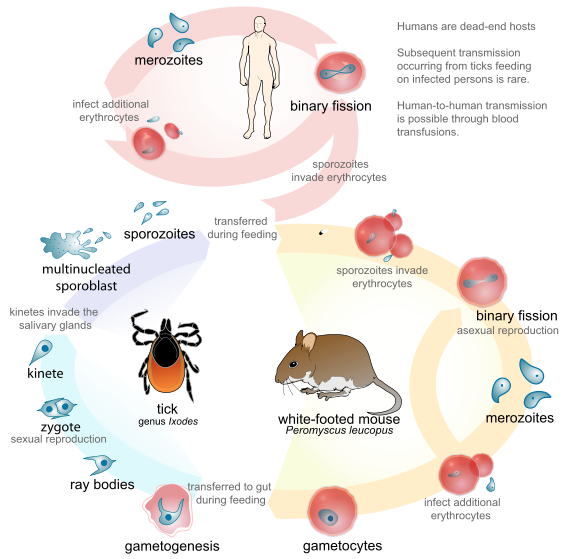
The Babesia lifecycle is presented below.  In mice the lifecycle is more interesting -- sexual reproduction. This allows for the transfer of genes from one organism to another. This is an evolutionary advantage RE the development of resistance.

In the human host the cells reproduce via an asexual process. The slides can look quite different at times. Most commonly small, dark staining round bodies are seen with Giemsa staining.

Resistance develops because random mutations -- mistakes made copying DNA -- occur with great regularity.

Sporozoites are released from an infected red blood cell.  The small forms attach to the cells and gain entry morphing into the larger merozoites. The merozoites divide in cells, rarely 2 at a time (Maltese Cross). The red cells rupture and the cycle repeats.

Additional information: sporozoites morph into an intermediary ring form, trophozoite before becoming a merozoite.  Ring form are readily observed.  Mature merozoites can rupture creating vermicules, small infective particles. These are harder to pick out. Intermediary morphological forms can present in many ways.